Smyrna households use the garage, which means the floor sees tires, bikes, and red dust from the yard. Flake is the spec. Older bays may have a peeling kit coat in the shape of two tires. That comes off in the grind.
Infill houses have newer slabs. Tell us the age. A 1960s stall and a new infill garage on the next street should not share a cure assumption.
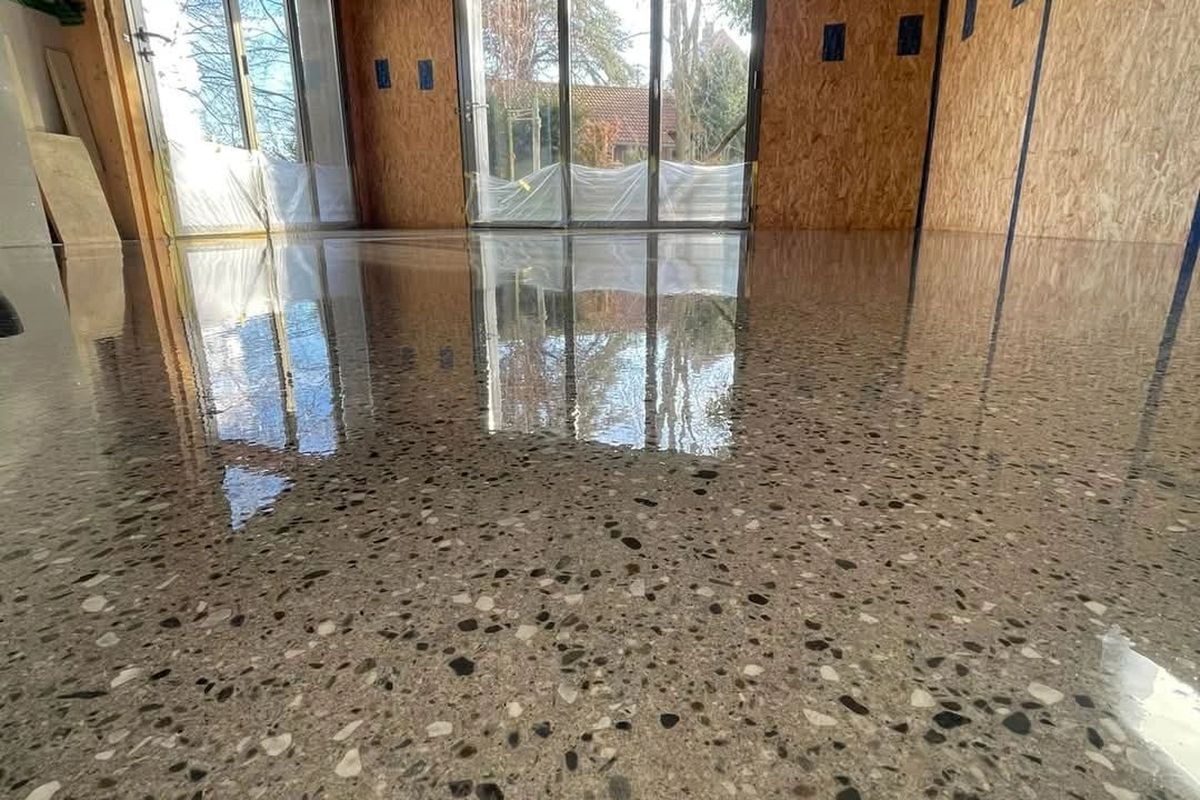
The photo is an example finish, not a documented Smyrna job.
A garage floor can look ready and still hold weak spots. Old sealers, oil, and leftover adhesive can keep a coating from bonding. A peeling kit coat needs to be removed, not covered. The installer should check how firmly any existing material is attached and plan for mechanical removal where it is not sound. A new-looking slab also needs inspection before it is treated as ready.
Slab age alone does not show whether moisture is a problem. Ask how moisture vapor will be evaluated before the coating is chosen. Calcium chloride testing measures moisture emission at the surface; in-slab relative humidity testing checks conditions inside the concrete. The methods are not interchangeable, and test results need to be compared with the coating system’s stated limits. If readings are too high, applying a coating without a suitable moisture plan risks failure.
Concrete preparation should create a consistent profile for the coating to grip. Diamond grinding removes weak surface material and can expose sound concrete; acid etching does not provide the same controlled profile and may leave residue. Ask what concrete surface profile, or CSP, the system requires and how the crew will verify it. A compatible primer may also be specified to support adhesion or address a particular slab condition.
Cracks and control joints need a plan before coating begins. A repair can reduce the appearance of a nonmoving crack, but it cannot promise that the crack will never return. Control joints are intentional breaks in the slab and are often treated differently from cracks. Ask which joints will remain visible, which will be filled, and what movement the repair material can tolerate.
For a garage that sees sunlight at the doorway, ask about the top coat’s UV stability. Some epoxy finishes can amber with UV exposure; a UV-stable polyaspartic or polyurea top coat may help preserve color, but the full system still matters. Epoxy, polyaspartic, and polyurea differ in working time and cure behavior. The right choice depends on the slab, installation conditions, and how soon the floor must return to service.
Flake coverage and the final top coat affect both appearance and traction. Ask whether the finish will be smooth or textured, and how slip resistance will be balanced with cleanup. Cure and recoat windows depend on the product and conditions, so keep the garage clear for the stated time. Afterward, use a soft broom or dust mop and a mild cleaner; avoid harsh tools that can wear the finish.
No. Grinding and coatings can improve the surface, but they do not make concrete perfectly uniform. Old patches, stains, repaired cracks, and differences in the slab can remain visible, especially beneath a solid-color finish. Ask for a clear explanation of what preparation can correct and what marks may still show.
That depends on the joint and the system design. Some joints are left open or are cut back after coating so the slab can move without tearing the finish. Others may be filled with a flexible material. Ask the installer to identify each joint and explain the proposed treatment before work starts.
Do not proceed with a standard coating as though the readings do not matter. Ask for the results in writing and for a compatible moisture-control plan, if one is appropriate. The installer should explain any added preparation and whether the proposed system is rated for the measured slab conditions.
The floor may be ready for foot traffic before it is ready for vehicle traffic. Confirm both times in writing, along with any limits for heavy items or turning tires. Temperature, humidity, coating thickness, and the selected system affect cure, so a generic promise should not replace the product’s instructions.
Start with a properly prepared slab and a coating system installed within its temperature and recoat limits. Give the floor the full vehicle-cure period before parking. Avoid turning the steering wheel while the car is stationary when practical, since concentrated tire friction can stress the coating over time.
Tell us about the floor in Smyrna. A photo and a rough size are enough to start a written estimate. No street address on our side — local pros come to the slab.
Atlanta Epoxy Floors is an independent referral service that connects you with local epoxy flooring pros.
 ATLANTA